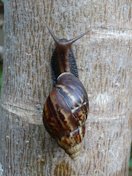
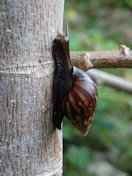
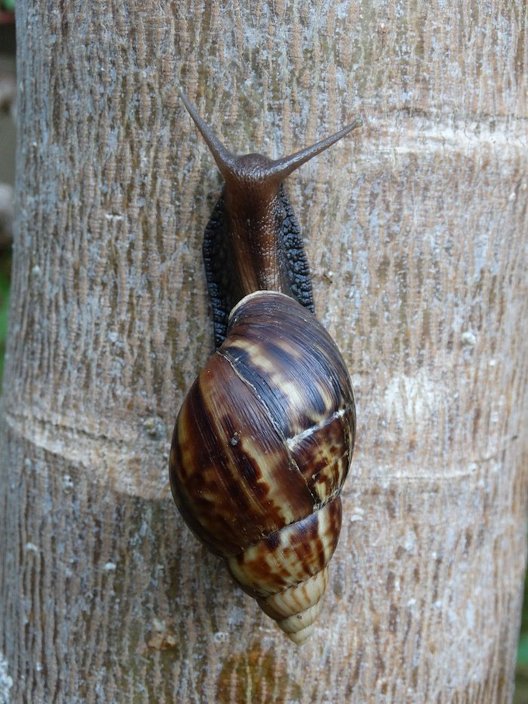
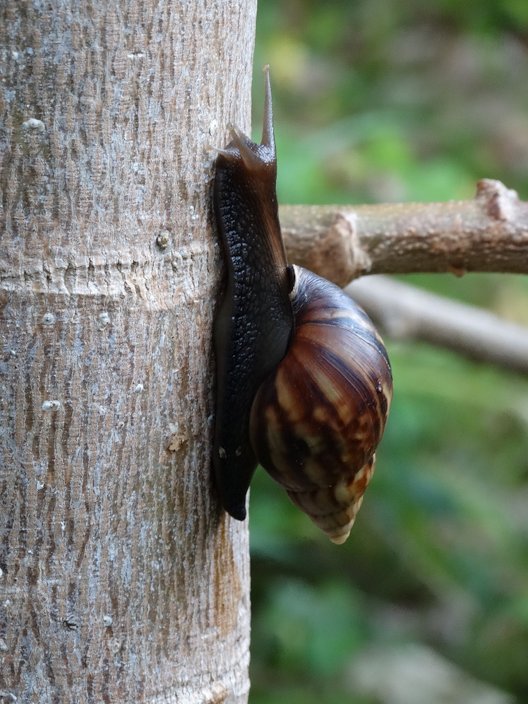
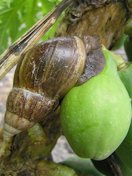
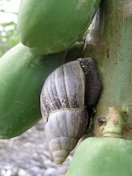
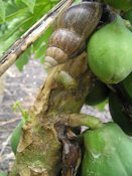
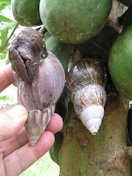
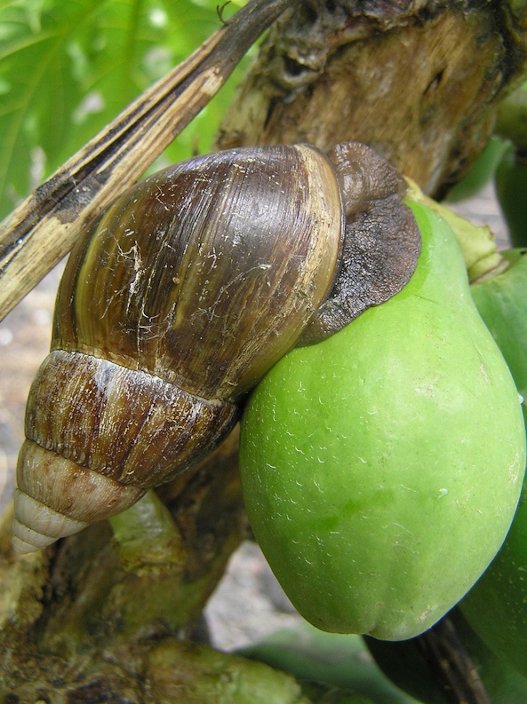
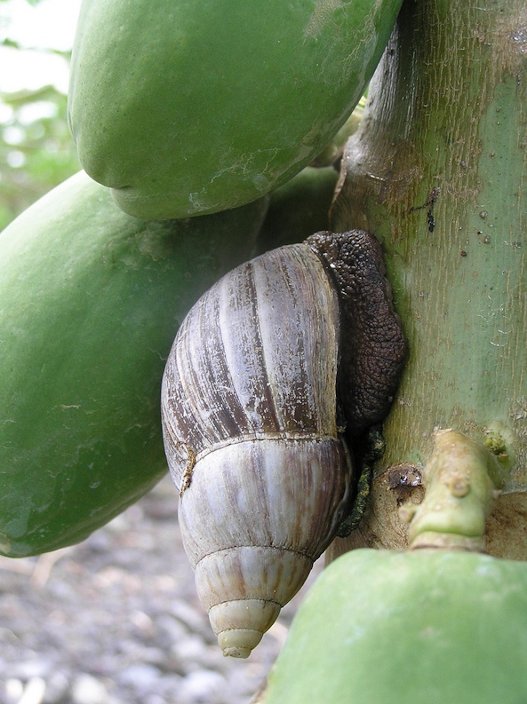
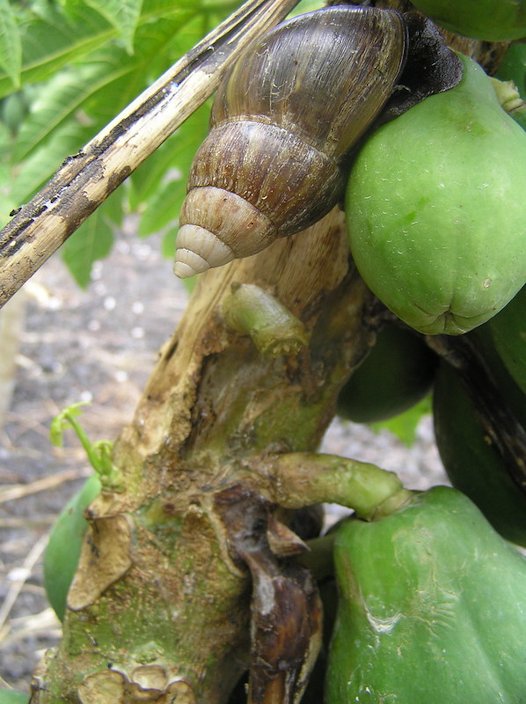
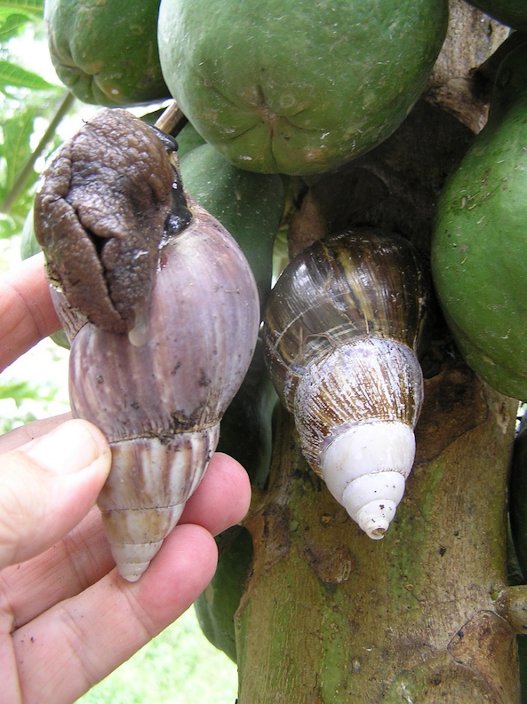
(Giant) African snail (Lissachatina fulica) Giant African land snail, Lissachatina fulica (formerly Achatina fulica), is considered by some to be one of the most damaging snails in the world. It has been observed to feed on at least 500 different types of plants, many of them crops. It is thought to have originated in East Africa, but has since spread through many countries in Southeast Asia and islands in the Pacific Ocean, including the Hawaiian Islands. More recently, this mollusc gained access to South America (Brazil) and the Caribbean islands of Martinique, Guadeloupe, Saint Lucia, Barbados and Saint Martin/ Saint Maarten. In early September 2011, it was found in Miami-Dade County of southern Florida. This is not the first occurrence of giant African snail in Florida. In 1966, a Miami, FL, child smuggled three giant African snails into south Florida when he returned from a trip to Hawaii. His grandmother eventually released the snails into her garden. Seven years later, more than 18,000 snails had been found along with scores of eggs. It was eventually eradicated, but it took 10 years at a cost of $1 million to eliminate this invader. Florida is now once again faced with an invasion by this snail. 1
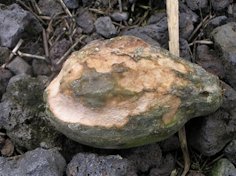
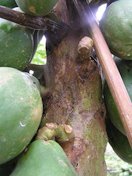
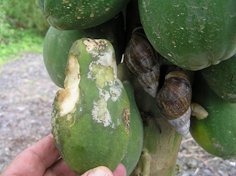
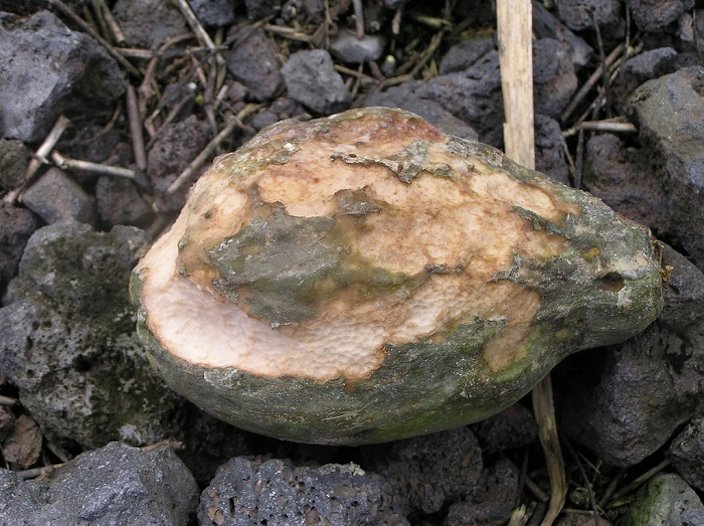
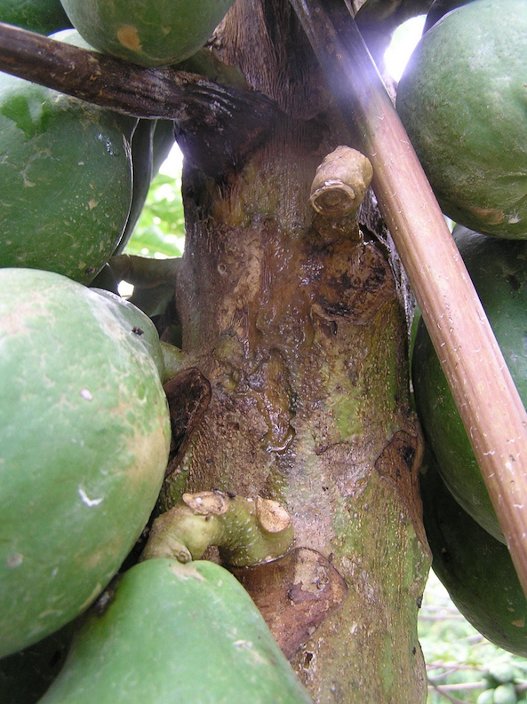
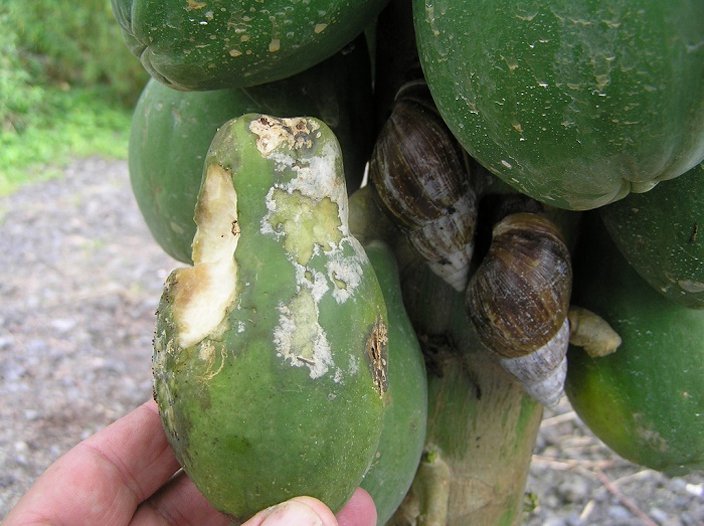
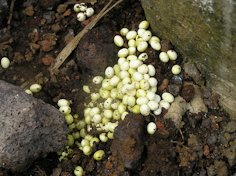
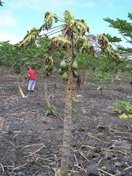
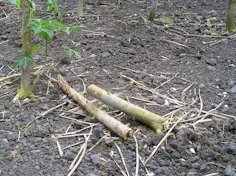
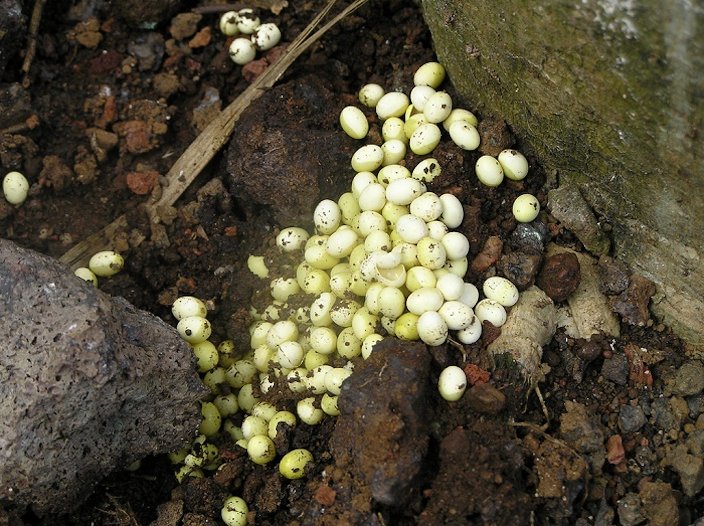
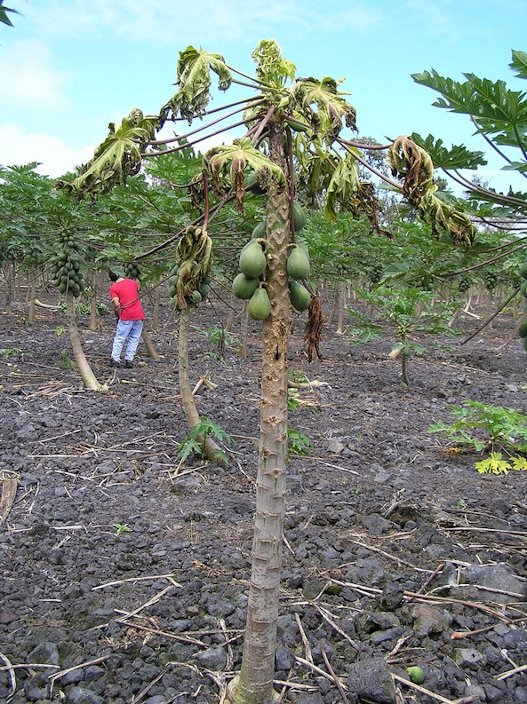
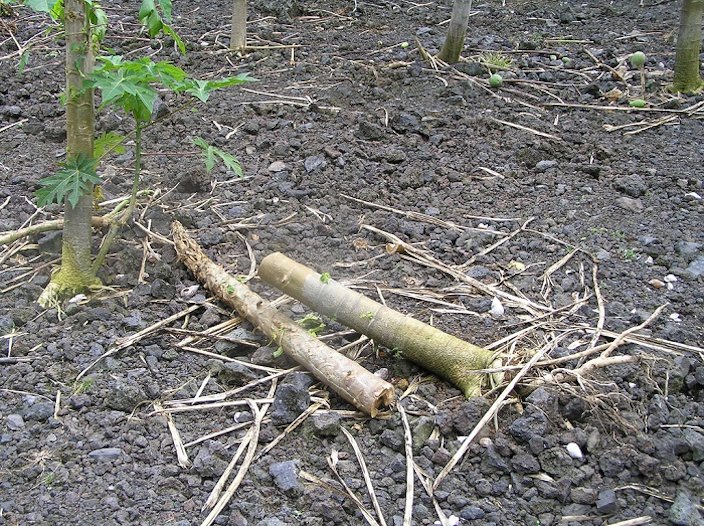
Fig. 4. African snail on papaya Fig. 5. African snail feeding injury to a papaya stem Fig. 8. Early Stem Injury Fig. 9. African snails (Achatina fulica) and their feeding injury to papaya fruits. The whitish mycelium is Phytophthora palmivora. Fig. 10. African snail eggs at the base of a papaya stem Fig. 11. African snail (Achatina fulica) feeding injury to a papaya stem Fig. 12. Death of the plants Giant African snails cause extensive damage on farms in Hawai'i and in natural ecosystems and pose certain risks to society. They affect papaya farming in the following ways: • loss of crop yield from feeding on papaya fruits; • death of papaya plants from snails feeding on the fruit-bearing, green portion of the stems; • increased fruit and stem blight caused by Phytophthora palmivora as the snail spreads the pathogen contact with its body; • increased farm costs (labor, materials, traps, molluscicides) associated with control of the snails; and • loss of the opportunity to grow papaya in certain locations due to the crop’s susceptibility to the giant African snail. 2 Giant African land snails often are large enough to be seen easily, so they can be collected by hand. It is advised to wear gloves, however, or to use an implement to pick up the snails because they can pose a serious health risk to humans. If you do collect snails, seal them in a plastic bag and then place the bag in a bucket or plastic container. Division of Plant Industry Helpline Contact us Monday - Friday, 8 a.m.-5 p.m. EST 1-888-397-1517 Florida Eradicated Giant African Land Snail 3 Oct 8, 2021 Tallahassee, Fla. — This week, Florida Agriculture Commissioner Nikki Fried and the Florida Department of Agriculture and Consumer Services (FDACS) Division of Plant Industry (DPI), along with the U.S. Department of Agriculture (USDA), announced the eradication of the giant African land snail (GALS) from Broward and Miami-Dade counties. This eradication announcement marks only the second time this pest has been eradicated in the world, both in South Florida. For the past 11 years, the FDACS Division of Plant Industry has worked toward eradication through multiple rounds of visual surveys and inspections, K-9 detector dog surveys and inspections, manual collection and treatment programs. In total, 168,538 snails were collected from 32 core population areas comprised of thousands of properties. This program has not just been a collaboration of the USDA and FDACS, but also the community. Over the years, multiple community and cultural groups, homeowners’ associations, green waste facilities, and homeowners themselves played strategic roles in disseminating the message of this invasive pest and the importance to report any sightings to the FDACS-DPI helpline. Because of this, 97 percent of the identified core population areas were reported by the public. GALS media kit, Florida Department of Agriculture and Consumer Services pdf APHIS Declares Eradication of the Giant African Snail (Lissachatina fulica, formally Achatina fulica) and Removes All Quarantine Areas in Florida pdf (Archived) Update May 2024 On June 2, 2023, a population of GAS was found in Miramar, Broward County, a new population not associated with the prior infestation. In June and December 2022, FDACS confirmed the detection of GAS in the New Port Richey area of Pasco County and along a stretch of the south bank of the Caloosahatchee River in Lee County (FDACS 2024), respectively. USDA APHIS confirmed the identifications of these populations. FDACS set up local surveillance, enacted quarantines, and began treatments to eradicate GAS. 4 There are currently three quarantine areas throughout Florida. These quarantines are in Broward, Lee and Pasco counties. It is unlawful to move the giant African land snail or a regulated article, including, but not limited to, plants, plant parts, plants in soil, soil, yard waste, debris, compost or building materials, within, through or from a quarantine area without a compliance agreement. 5 Giant African Snail Cooperative Eradication Program in Florida, Final Environmental Assessment pdf  Fig. 13  Lifecycle of Giant African Land Snail Think you found a giant African land snail? Refer to the ID sheet. Still not sure? Email a photo for identification to DPIHelpline@FDACS.gov. GAS is widespread in Hawai'i. They are also established in American Samoa, Guam, and the Mariana Islands. Further Reading Florida Snail Identification Sheet, Florida Department of Agriculture and Consumer Services pdf Comparing GALS to Ghost Snail, Florida Department of Agriculture and Consumer Services pdf Giant African Land Snail in Florida, University of Florida pdf Pest Alert Giant African Snails, Florida Department of Agriculture and Consumer Services pdf Injuries Caused by the Giant African Snail to Papaya, University of Hawai'i at Mānoa pdf Back to Papaya Pests Page | ||||||||||||||||||||||||||
| Bibliography 1 Capinera, John L. "Giant African Land Snail in Florida." Entomology and Nematology Dept., UF/IFAS Extension, ENY-512, Original pub. Oct. 2011, Revised Feb. 2021 and Aug. 2024, AskIFAS, edis.ifas.ufl.edu/in904. Accessed 20 Feb. 2017, 9 Aug. 2020, 25 Feb. 2022, 8 Nov. 2025. 2 Nelson, Scot. "Injuries Caused by the Giant African Snail to Papaya." College of Tropical Agriculture and Human Resouces, University of Hawai'i at Mānoa, June 2012, CTAHR, ctahr.hawaii.edu. Accessed 20 Feb. 2017. 3 "Florida Eradicates Giant African Land Snail." Press Release Oct. 2021, Florida Department of Agriculture and Consumer Services, FDACS, Archived, www.fdacs.gov/News-Events/Press-Releases/2021-Press-Releases/VIDEO-Florida-Eradicates-Giant-African-Land-Snail. Accessed 24 Feb. 2022. 4 "Giant African Snail Cooperative Eradication Program in Florida, Final Environmental Assessment." USDA, Animaol and Plant Health Inspection Service, May 2024, www.aphis.usda.gov/sites/default/files/giant-african-snail-florida-ea-may-2024.pdf. Accessed 8 Nov. 2025. 5 "Pest Information." Florida Department of Agriculture and Consumer Services (FDACS.gov), www.fdacs.gov/Agriculture-Industry/Pests-and-Diseases/Plant-Pests-and-Diseases/Invasive-Mollusks/Giant-African-Land-Snail. Accessed 8 Nov. 2025. Photographs Fig. 1,2 Nelson, Scot C. "Papaya (Carica papaya): Giant African snail (Achatina fulica)." Pest and Disease Image Gallery, University of Hawai'i, 2017, Flickr, (CC BY-SA 2.0), flickr.com. Accessed 20 Feb. 2017. Fig. 3,4,6 Nelson, Scot C. "Africans snail (Achatina fulica) on papaya." Pest and Disease Image Gallery, University of Hawai'i, 2006, Flickr, (CC BY-SA 2.0), flickr.com. Accessed 20 Feb. 2017. Fig. 5,7,8,11 Nelson, Scot C. "African snail (Achatina fulica) feeding injury to a papaya stem." Pest and Disease Image Gallery, University of Hawai'i, 2006, Flickr, (CC BY-SA 2.0), flickr.com. Accessed 20 Feb. 2017. Fig. 9 Nelson, Scot C. "African snails (Achatina fulica) and their feeding injury to papaya fruits. The whitish mycelium is Phytophthora palmivora." Pest and Disease Image Gallery, University of Hawai'i, 2006, Flickr, (CC BY-SA 2.0), flickr.com. Accessed 21 Feb. 2017. Fig. 10 Nelson, Scot C. "African snail (Achatina fulica) eggs at the base of a papaya stem." Pest and Disease Image Gallery, University of Hawai'i, 2006, Flickr, (CC BY-SA 2.0), flickr.com. Accessed 20 Feb. 2017. Fig. 11. Nelson, Scot C. "African snail (Achatina fulica) feeding injury to a papaya stem." Pest and Disease Image Gallery, University of Hawai'i, 2017, Flickr, (CC BY-SA 2.0), flickr.com. Accessed 20 Feb. 2017. Fig. 12. Nelson, Scot C. "Death of the plants." Pest and Disease Image Gallery, University of Hawai'i, 2017, Flickr, (CC BY-SA 2.0), flickr.com. Accessed 20 Feb. 2017. Fig. 13 "Lifecycle of Giant African Land Snail." Florida Department of Agriculture and Consumer Services, www.fdacs.gov/Agriculture-Industry/Pests-and-Diseases/Plant-Pests-and-Diseases/Invasive-Mollusks/Giant-African-Land-Snail. Accessed 8 Nov. 2025. Published 20 Feb. 2017 LR. Last update 8 Nov. 2025 LR | ||||||||||||||||||||||||||